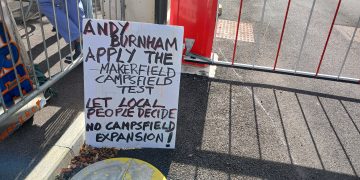
Oxfordshire County Council’s Cabinet confirmed on 17 October that existing Low Traffic Neighbourhoods (LTNs) will be permanent. This was recommended by council officers and has the support of a variety of sustainable transport organisations based in Oxford. Attempts to mobilise and to mislead the public in the Oxford Mail, and by campaign group Reconnecting Oxfordhave failed to persuade the County’s Lib Dem / Green Party ruling coalition. All three parties on Oxford City Council – Labour, Lib Dem and Green – support the LTNs too.
If we distil the distinctions between the sides in this debate, they can be characterised as follows.
On the one hand, Council and voluntary groups support efforts to reduce traffic movements within Oxford, which is the major employment centre in Oxfordshire with concentrations of hospitals, schools, universities and publishing. Population growth in the city and housing development around it – both built and planned – can only make traffic worse, and will require long-term measures to deal with traffic movements.
On the other hand, taxi drivers, some businesses and areas of the city near the BMW supply-chain on the eastern fringe oppose LTNs. They have attracted external support from climate-change-denying groups, conspiracy theorists and even anti-vaxxers. This taints this oppositional movement as anti-intellectual, undermining its credibility to councils and most of the public.
Opposition claims of LTNs having negative effects upon businesses do not consider that the continuing cost of living crisis, particularly with regard to energy and food costs, contribute to retail outlets showing a downturn throughout the city. This has occurred in areas like the City Centre where there are no new LTNs. Evidence of businesses benefiting from LTNs is ignored. Evidence on how LTNs and traffic calmed areas are good for business is in fact extensive.
Despite noisy, minority opposition lacking political support, Oxfordshire County Council has already decided to put in traffic filters supported by Automatic Plate Number Recognition (ANPR) on six major roads in Oxford, which will be introduced in 2024. Very generous exemptions, notably for taxis, are to be applied.
The future
The above measures alone will not permanently address traffic problems in Oxford. The Department for Transport (DfT) expects the current 40 million vehicles in the country to grow by 22% by 2060. However, this average does not consider that the growth of settlements will be unevenly distributed with larger traffic impacts in some locations. Oxford, a victim of its comparative success, is the second most popular city for cycling in the country (after Cambridge), which is in part in response to its chronic traffic problems. Housing and employment growth in and near Oxford is currently working in the opposite direction to all forms of traffic calming measures.
One major problem is that pedestrianisation in Oxford is very poor in scale and quality. Coach parties, language school groups, people on guided walks, students, tourists and locals all bunch into areas where there should be a lot more pedestrianisation to accommodate them. Successive councils (County and City) have not extended pedestrian areas to cope with this as have Norwich and York. Resistance from bus companies and taxi firms has been successful up to this point, but there comes a point when further actions to relieve congestion is unavoidable. The benefits of pedestrianisation are many and well-documented.

What future improvements could there be to make sustainable forms of transport dominant in Oxford. One option is the pedestrianizing most of the area between the City Centre and the Railway Station. The latter is currently being rebuilt in a long-overdue upgrade, including additional line capacity and a new bridge over the Botley Road in the west of the city. This type of central area pedestrianisation might seem an obvious thing to do, and is not unknown in other cities. We may consider how shifting the current coach station from its congested central location at Gloucester Green to Becket Street car park quite close to the Railway Station in the west. This would create a better transport hub than crowding buses and coaches into the narrow confines of George and Magdalen Streets – themselves both candidates for pedestrianisation.
Traffic Filters
Oxford already has six major roads with traffic filters backed up by ANPR, albeit with generous exemptions going well beyond emergency vehicles. However there are two further roads with major congestion issues. The first is Botley Road runs west out of central Oxford past the Railway Station and acts as a ‘funnel’ for huge car movements not just from Botley but communities beyond. It is currently closed as the new railway bridge is being constructed with a deeper underpass.
Then there is the Abingdon Road going north-south. This is a generally narrow road, ill-suited to the rush hour and school run burden it carries. The decision of the City Council to let the Westgate Shopping Centre fix lower car parking charges than the Council recommends. So in consequence, queues of vehicles heading for cheap parking often extend south down the Abingdon Road. This emphasises what happens when you do not apply joined-up transport thinking.
Both the above-mentioned roads need traffic filters, like the six major roads mentioned above, to deter traffic from entering Oxford City Centre. Promotion of Park and Ride sites, such as the Seacourt Park and Ride in Botley, has not been justified as reductions in car parking within Oxford have yet to take place at an adequate scale. Reclaiming car parks and other sites in the city for residential use seems more effective at reducing car traffic than creating satellite communities outside Oxford. Also, Oxford’s road space remains too generous for vehicles. More space is needed for wider cycle tracks, better walking provision, pavement repairs, and in some places additional bus lanes.
The future for Oxford is decades of pursuing sustainable transport despite the active opposition from those who will not recognise how bad the congestion and pollution in the City is, or how bad it will get, if traffic is not radically curtailed.
Ed: The views expressed here are those of the author.
We want to hear your views. Please send any comments to editor@westenglandbylines.co.uk

CLICK HERE TO DONATE TO OUR CROWDFUNDER
HELP US BECOME STRONGER SO THAT WE CAN CONTINUE TO DELIVER POWERFUL CITIZEN JOURNALISM!