Let me start with two clear statements. I am a Labour Party member. I do not support Palestine Action.
I don’t mean that I oppose them. I don’t know enough about them to take a firm position. I simply have some questions about what motivates them and I am wary that a wider movement, one I very much support and which cares about our fundamental right to protest, is at risk of being captured by a particular and contentious issue. Many members of the Green Party might sympathise with my concerns.
Arrests that are doomed to fail
But what I do feel strongly is that arresting and criminalising individuals who hold up signs that say “I oppose genocide. I support Palestine Action” is unnecessary, disproportionate, fundamentally anti-democratic and also doomed to fail. If those objections don’t work for some, how about the point that it is simply “anti-British”?
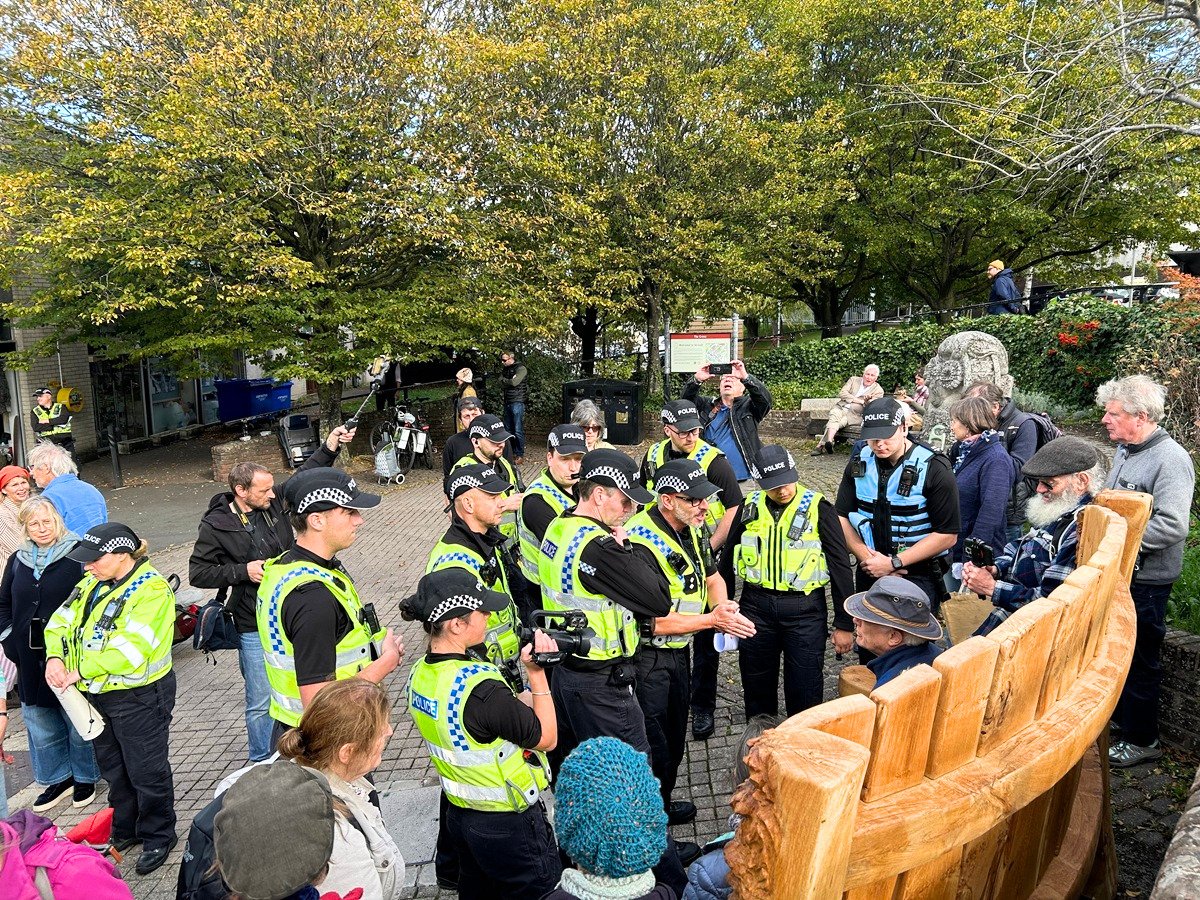
I was in Stroud at 11am on Saturday 10 October, 2026 where a number of friends staged a peaceful protest – of course, these events are always peaceful. It involved sitting on a bench in the sunshine in a quiet corner, holding signs with the words I have just spelled out. The words on those signs could be read by around 20 people. And 12 or more of those were police officers.
Yes, our Chief Constable had presumably decided that the presence of police officers at the scene was the best use of police resources, whilst, at the same time, lamenting that such resources are regrettably constrained in other places. By deploying her officers at the event, she ensured that the signs were read by more people than would otherwise have been aware of them. I would love to hear her justification for spreading ‘sedition’.
What does ‘support’ here even mean?
I know the arguments. Palestine Action is proscribed. It is also unlawful to “support” that organisation. But as a lawyer I look at the words used. I would have thought that “support” would mean giving money, giving aid and sustenance, doing something tangible.
Section 13 of the Terrorism Act 2000 however makes it an offence, punishable by up to six months in prison, to “wear, carry or display clothing or articles in public that arouse reasonable suspicion that an individual is a supporter of Palestine Action”. However, the drafting contains no actual definition of “support” and is so circular and subjective that I wonder how it will survive a sophisticated court challenge. I would help fund that challenge.
I was at Labour Conference last month. There was a protest outside the secure zone, where the organisers had agreed to sit out of sight of the delegates. I found the protest only by going out of my way, because I thought some of my friends might be there. I would say that, once again, the only people who could see their signs without a major detour were the 60 to 80 police officers who first corralled them and then arrested them. And that is the pattern.
When ‘2-tier policing’ is real
This kind of police strategy illustrates a genuine case of “two tier policing” that Farage could really get his teeth into. Black balaclava thugs turn up unannounced, cause mayhem, and are then escorted away. Broadcasters report that the police described the event as “spontaneous” and also “peaceful” on the basis that there were no arrests, despite the naked intimidation and criminal damage. The police knew arrest would be resisted by the Tommos, so they didn’t attempt it at the time.
But when the Quakers or other peaceful groups follow the rules, notify the police about the time and location of their protest, they get arrested in droves. This isn’t Robert Peel’s policing by consent. It’s an abdication of policing in the face of dissent, followed by over-policing of the compliant.
Pointless, performative deterrence
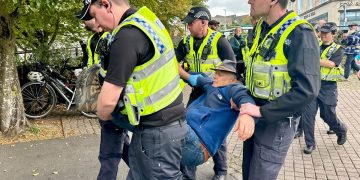
Meanwhile, around the country we are arresting people who are no threat to our way of life, who are polite and gentle with the police officers, and whose only resistance is in insisting on being carried to the police vans rather than walking.
The policing in these contexts is purely performative, because in the absence of the police there’s barely an offence to witness. The arrestees are detained for hours and then let go. When the cases get to court, so many of them are thrown out. It’s a pointless, petty waste of time. And it needs to stop.
I don’t take a position on whether Palestine Action should be proscribed. But should it really be an offence to think they should not? Should it be an offence to bear witness to that belief by simply holding a sign, in the sunshine, on a bench in a very quiet corner of Stroud?
Comments? We want to hear them. Please write to editor@westenglandbylines.co.uk

What happens when the media itself becomes part of the problem? Who holds it to account? 14 years after the Leveson Inquiry reported its findings, has anything really changed? And how can we build something better?
Join Bylines Network on Wednesday 21 October, for a vital conversation about the media Britain needs — and what it will take to get there.
The event will conclude with a live audience Q&A.