This Monday, 25 January 2021, four Bristolians went to court. Their crime: Tearing down the statue of the celebrated benefactor of the city from the 1700s, Edward Colston, merchant and slave trader.
The event occurred in Bristol city centre during the most prominent Black Lives Matter (BLM) protest, on 7 June 2020. A demonstration that attracted thousands of protestors.
When the statue was torn down that day, most of the protesters applauded this action which had been requested officially by diverse groups and activists for over the past three decades. The photographs of the scene of the falling and the dumping of the bronze statue into the Harbour toured the internet globally.
The protests, the march and the statue’s removal were all peaceful; no one was harmed and even the bronze statue itself was salvaged. Fetched from the water, it is now sitting in the M Shed and will most likely be exhibited with other objects and artworks related to Colston’s and Bristol’s historical role in the triangular trade.
So, on these grounds, many in Bristol question why four people are now facing prosecution for such action.
Rhian Graham (29), Milo Ponsford (25), Jake Skuse (32) and Sage Willoughby (21) appeared at Bristol Magistrates Court this Monday, charged with causing criminal damage to the statue of Edward Colston.
On behalf of the group “Countering Colston”, the former Lord Mayor of Bristol and Green City Councillor, Cleo Lake, wrote:
“These four young people were selected out of a crowd of hundreds who cheered as the statue of Edward Colston, a leading organiser and profiteer from the enslavement of African people, was dumped into the Floating Harbour … Whilst we do not endorse criminal damage, we do not support any prosecution as it is neither in the public nor Bristol’s interest in terms of where we are presently as a city. Non-prosecution would be a step towards reconciliation and healing.”
Cleo also added on Twitter:
“Don’t prosecute the #Colston4. We need a British State that can listen, recognise & acknowledge the reasons why the statue had to go & start to prioritise healing, reconciliation & repairs from the magnitude of legacies left by.”
I couldn’t agree more. Yet the trial opened this Monday.
Why do I care about the Bristol Four?
I came to Bristol as a foreign reporter for the first time in February 2015, and I was very aware of Colston’s legacy and controversy. Since, I have spent years doing research on the recent cultural history of the city. I had chosen Bristol, after years as a reporter on African affairs for the BBC World Service and other international broadcasters, precisely because I thought its complex history was the perfect mirror for the world we live in. No year has illustrated this intuition was right more than 2020.
On the one hand, the artists I interviewed, met and discussed with (Robert Del Naja, Tricky, DJ Flynn to name a few) embodied the success of a counter-culture born out of immigration, Caribbean culture, rebellion and vocal demands for system change, through raps, lyrics, performances and activism. Del Naja for instance always refused to perform in the Music Hall as long as it was named after Colston.
On the other hand, it was obvious from my first visit that the legacy of not only Colston but the whole history of the British Empire and its colonial brutality and centuries of slavery was not over. Many in the city are demanding change, the end of inequality and better prospects for the people of colour in the city, one of the most unequal in England according to some surveys.
What does Bristol think?
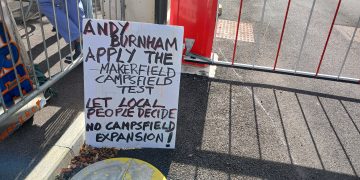
In the days leading up to the trial, messages of support appeared on placards all over Bristol. On Monday morning, an online support event took place, accessible from Facebook.
But in some parts of Bristol, as in the rest of the country, there are still many people who defend the prosecution. Statues are public property, they say. Colston did a lot of good for the city, others add.
But as the entrepreneur Daniel Edmund, who spoke at the demo, said in a film, “Felling of Colston” by Arthur Cauty, shown in an online event organised with the Cube Microplex Cinema on Monday evening, Bristol was hardly known worldwide before 2020 but finally made history in the wake of the US-started Black Lives Matter (BLM) protests for George Floyd.
Lanie, street mural artist, made the mural for BLM on Jamaica Street. He said in the a same film – Felling of Colston by Arthur Cauty – that she felt the way the statue was torn down felt like “the only way it could have come down”, because there were years of campaigning before 2020 that remained unheard by the authorities.
Historian David Olusoga told again that statues do come down, they come down all the time; they change as society evolves: “Germany is full of statues of Hitler; nobody would put them on the streets today”.
And at the hearing…
During the 15-minute hearing on Monday morning, the District Judge Lynne Matthews said the case could “be dealt with in a magistrates’ court” but the four exercised their right for the case to be heard in a crown court. They were all given unconditional bail and told to appear next before Bristol crown court on 8 February.
After the court hearing, solicitors Hodge Jones & Allen, who represent three of the four defendants, said:
“We will fight these criminal charges vigorously. We are committed to defending them and their right to a fair trial in this important case.”
My memories on the 7 June march
I was at the march myself on 7 June. I had been waiting for that statue to be taken down for five years. I went with friends from the Indian Ocean and we were surrounded by hundreds from all backgrounds. As we moved forward in the middle of the crowd, I told one of my friends that we were indeed walking toward the plinth. I didn’t know what was planned or about to happen, and I truly think most people didn’t know. I said “we’re aiming for Colston’s statue…”. My friend replied: “Come on this can’t happen, this is Britain after all”. Britain maybe, but also rebel Bristol!
In the evening I wrote this column for The Independent’s “Voices”, stating that our city made history. I wrote:
“For me, as my own family has been deeply affected by colonialism elsewhere in the world, it is puzzling to hear some English people still defending the statue based on the understanding of our shared history. France wouldn’t erect statues of Petain, or Germany of Hitler, just for the sake of remembrance of our criminal pasts.”
I was really proud of the marchers, and proud to be humbly among them, part of an actual step for change. I thought and still think that the people who disagree, who think they are protecting their ‘white’ English culture when they want the statue back, only need to understand, do their own research, and listen to their fellow citizens, black and people of colour who have also been part of this country’s history for centuries if not more.
What is a crime?
For I believe no one wants to defend the right to enslave, no one can reasonably state they want to. It’s pure crime, and it is still a sick disease ruining our modern societies. If you defend it, you defend true crime. In France, where I grew up, it’s even designated by the law as “crime against humanity”. So we should seriously ask ourselves: Who deserves prosecution in this situation, slave traders or “statue topplers”?
Let us hope that the “Bristol Four” will be acquitted just as the “Mangrove Nine”, a group of British black activists tried for inciting a riot at a protest in 1970, were.